C. S. Lewis’s childhood experiences of Joy
Surprised by JoyC. S. Lewis’s childhood experiences of Joy were fleeting encounters with an intense, unfulfilled longing, awakened by a toy garden recalled beside a flowering currant bush, the autumnal world of Squirrel Nutkin, and a few lines about Balder. He distinguished these moments from daydream and ordinary pleasure: Joy was the desire itself, more desirable than any satisfaction, yet never something he could summon or keep. In his retrospective account, these childhood glimpses became a defining pattern of his inner life and the central thread of his personal story.
Three Glimpses
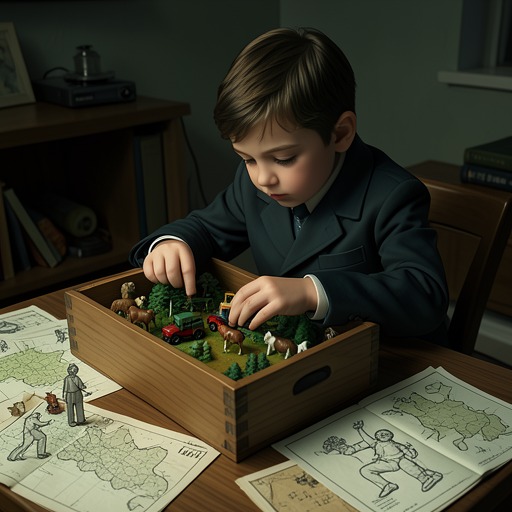
The first episode began beside a flowering currant bush on a summer day. Without warning, Lewis remembered not simply his childhood but an earlier memory: his brother bringing a toy garden into the nursery at the Old House. The sensation that followed seemed to come from a depth measured not in years but in centuries. He compared its force to Milton’s description of Eden as “enormous bliss,” recovering the word’s full ancient meaning. The longing involved the toy garden, but could not be reduced to a biscuit tin filled with moss, or even to a wish to return to his past.
Before he could understand what he wanted, the desire vanished. The world became commonplace again, leaving only a longing for the longing that had just ceased. The whole encounter occupied a moment, yet Lewis judged it more significant than anything else that had happened to him. Its structure—an overwhelming summons followed almost immediately by loss—would recur in the other glimpses.
The second came through Beatrix Potter’s Squirrel Nutkin. Lewis loved all the books, but the others entertained him; this one troubled him by awakening what he called the Idea of Autumn. The response was like being enamored of a season, and again it took the form of intense desire. He returned to the book not because it could satisfy that desire, but because reading it could reawaken it. Autumn itself could not be possessed. As in the first episode, the experience struck him as unexpectedly important and as belonging to a dimension beyond ordinary life and pleasure.
The third glimpse arose from poetry. Lewis had enjoyed Longfellow’s Saga of King Olaf for its story and vigorous rhythms, but while turning through it casually he encountered an unrhymed translation of Tegner’s Drapa. Its lines declared that Balder the beautiful was dead. Lewis knew nothing about Balder, yet the words immediately lifted him into immense regions of northern sky. He desired something he could not describe except through qualities of coldness, spaciousness, severity, paleness, and remoteness. Even as the longing came, he felt himself falling out of it and wished to return.
What Lewis Meant by Joy
Lewis insisted that these experiences were not interchangeable with reverie, wish-fulfilling fantasy, Happiness, or Pleasure. He distinguished the invention of Animal-Land from daydreaming: in the imagined country he was its creator, not a character seeking admission. He regarded that work as training in the craft of the novelist, while the three glimpses belonged to another and higher sense of imagination. They were not worlds he had made or fantasies in which he could cast himself; they arrived through memory, a storybook, and poetry, and remained beyond his control.
The common quality, Lewis explained, was an unsatisfied desire that was itself more desirable than any satisfaction. He gave this experience the technical name Joy and separated it sharply from Happiness and Pleasure. Its one shared feature with those states was that anyone who had experienced it wanted it again. In quality, however, it could almost be called unhappiness or grief—an ache that the person experiencing it nevertheless wanted. Lewis doubted that anyone who had tasted Joy would exchange it for all the pleasures in the world, while observing that Joy could never be commanded in the way pleasure often could.
Memory, Loss, and the Inner Life
Lewis could not be certain whether the three glimpses happened before or after his mother’s illness and death. He placed them in a childhood whose chronology was already marked by a family loss he was about to recount, but did not assign the experiences a definite order around it. That uncertainty matters to his presentation: Joy is recovered as a pattern of memory, not as a neatly dated series of episodes.
The episodes also establish a contrast between what can be described and what resists possession. Lewis can identify the triggers—a flowering bush and the remembered toy garden, Squirrel Nutkin, and the lines about Balder—and record the physical and imaginative force of each response. But he cannot name the object of desire itself. Each glimpse points beyond its immediate occasion, then disappears, leaving the desire for its return. The incompleteness is not an incidental flaw in the account; it is the experience’s defining condition.
A Pattern Revisited
Lewis later described his school years as two lives at once: an outer existence of weariness and difficulty, and an inner life in which moments of imaginative intensity could reveal what seemed like whole heavens. He compared the outer and inner accounts to oil and vinegar, a river beside a canal, and Jekyll and Hyde. The flashes of the inner life might last only seconds, scattered through months of ordinary hardship, yet from within that life the surrounding experiences could seem like a coarse curtain, momentarily drawn aside.
The landscapes and sensations associated with longing sharpen the contrast. From the hills above Belfast, the industrial city below appeared as smoke, noise, shipyards, and a hated office, while sunlight, grass, dew, and the distant Mourne Mountains opened a different imaginative prospect. Lewis later described this kind of doubleness as shaping how he remembered Wyvern: the outer account did not make the inward moments false, and the inward moments did not erase the outer life. His childhood Joy thus functions not as a sustained state of happiness, but as a recurring glimpse whose brevity intensifies its force: it gives him a desire he cannot satisfy, and leaves its absence present as longing for the lost longing.